· By Shanon Ohmann
The short answer: If you inherit a home in Orange County, you have three main options: live in it, rent it out, or sell it. Your decision turns on two California and federal rules. Under Prop 19, a child who moves in within one year can usually keep a parent's low property tax base; anyone else, including landlords, is reassessed at today's market value. And thanks to the federal step-up in basis, heirs who sell soon after inheriting usually owe little or no capital gains tax. Selling often makes the most financial sense when no heir plans to live there, but keeping the home can be the right choice for many families.
I've helped many families in South Orange County through this decision, often while they are also grieving. There is no single right answer, so here is how to think it through clearly.
First steps after inheriting
Find out how the home is passing to you. If it is held in a living trust, the successor trustee can usually transfer or sell it without court involvement. If not, it may need to go through probate, which can take months. A probate or estate attorney can tell you which path applies.
Get a date-of-death appraisal. This sets your new tax basis for capital gains, so it matters whether you keep or sell.
Secure and insure the home. Notify the homeowners insurance company, especially if the home will be vacant. Many policies limit coverage on empty homes.
Understand the Prop 19 deadline. Under Proposition 19, a child can keep a parent's property tax base only if the home was the parent's primary residence and the child moves in and files for the homeowners' exemption within one year of the transfer. The protected amount is capped at the parent's taxable value plus $1,044,586 for transfers between February 16, 2025, and February 15, 2027. Rental and vacation homes no longer qualify for any parent-child exclusion.
Why the deadline matters (illustrative): Say your parents bought their Mission Viejo home in 1985, and its taxable value today is about $250,000. The home is worth $1.2 million. If you move in within a year, your base tax stays near $2,500 a year. If you rent it out or leave it vacant, it is reassessed to about $1.2 million, and the base tax jumps to about $12,000 a year.
The costs of keeping the home
An inherited home is never truly free. Before deciding to keep it, add up what it will cost to own each year:
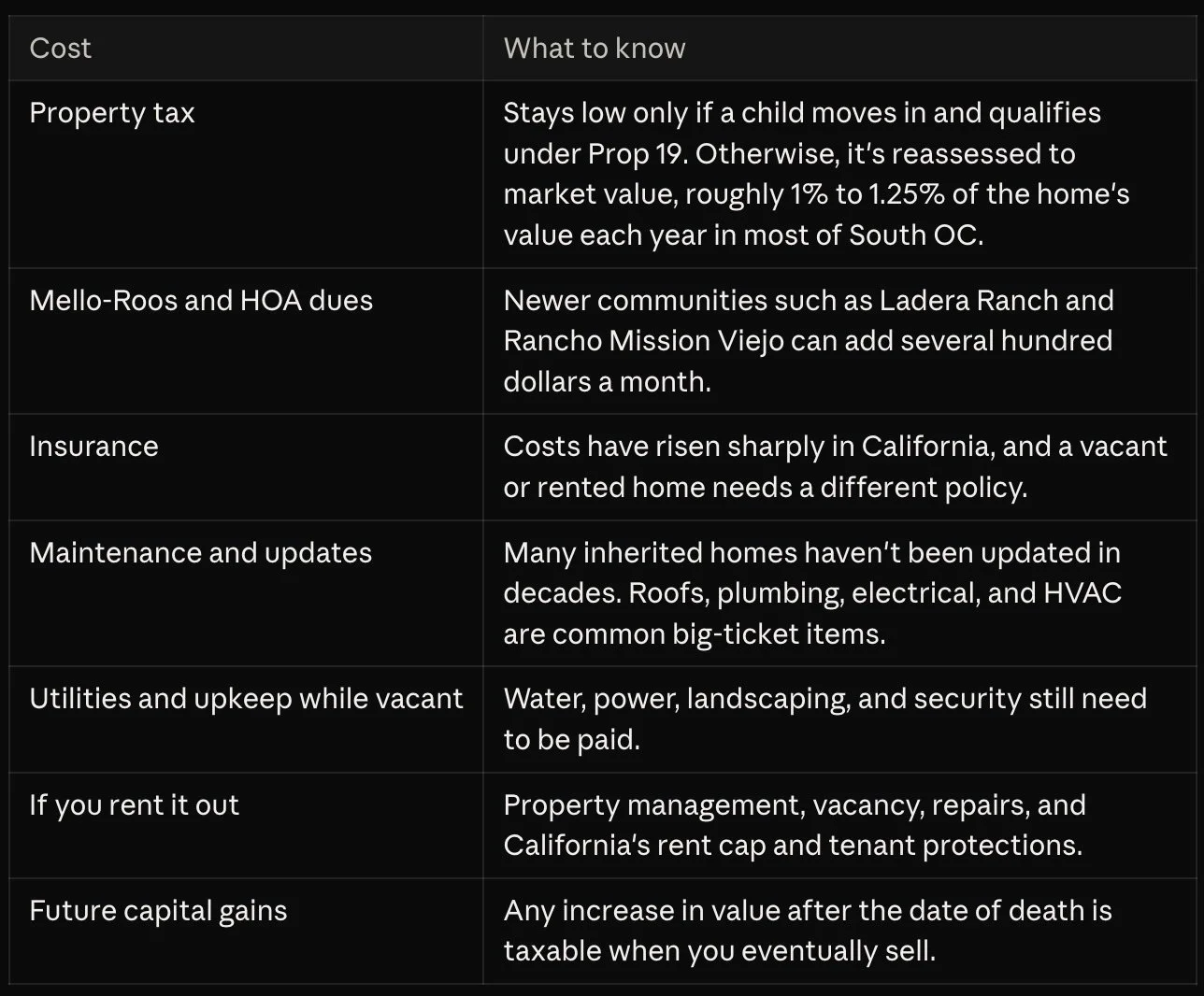
If several siblings inherit together, keeping the home also means agreeing on who pays what, who manages it, and when to sell. That's often the hardest part.
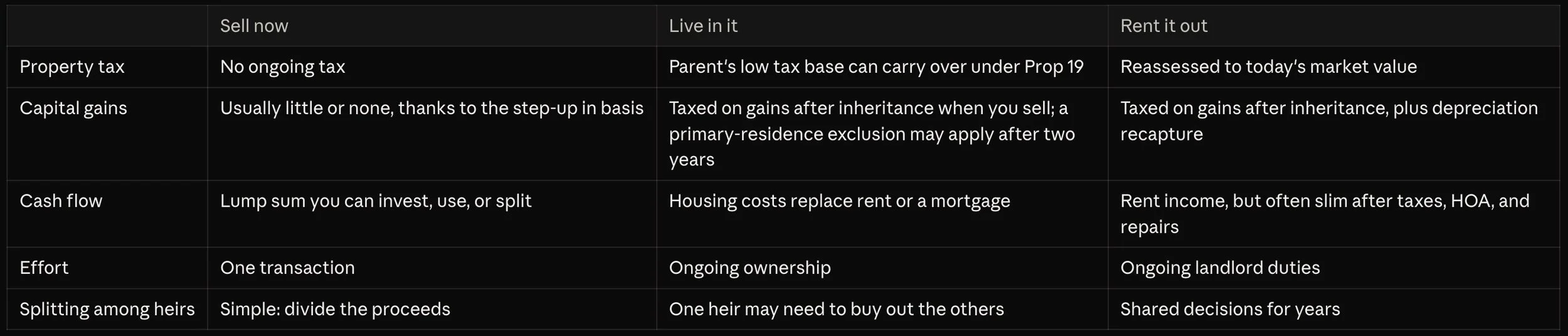
Selling now vs. living in it vs. renting it out
Why selling soon can make sense
Minimal capital gains tax. Inherited property receives a stepped-up basis equal to its value on the date of death, so heirs who sell soon after usually owe tax only on a small amount of appreciation, if any.
No reassessment shock. If no heir will live there, the property tax resets to market value. Selling avoids paying that higher tax year after year.
Strong South OC values. The Orange County single-family median reached $1,456,000 in September 2026, up 4.7% from a year earlier, so you're selling into a solid market.
A clean split. Selling turns one shared asset into cash each heir can use in their own way, which often protects family relationships.
No landlord risk. Renting a reassessed home rarely cash-flows well in South OC, and California's tenant protections make it harder to sell quickly later.
When keeping it makes sense
A child wants to live there and can keep the parent's tax base under Prop 19.
The home has deep family meaning, and the family can comfortably afford to keep it.
You're a long-term investor comfortable with landlord duties and modest cash flow in exchange for future appreciation.
My take: Take the time to gather all the numbers first, including what the home is worth today and what it could rent for. If several family members are involved, make sure everyone has time to review those numbers as well. Sometimes the decision to keep or sell is clear right away, and sometimes it takes time. Either way, having a clear picture is what helps your family move forward with confidence.
Frequently asked questions
Do I have to pay capital gains tax when I sell an inherited home in California? Usually very little. Your basis steps up to the home's value on the date of death, so you're generally taxed only on any increase after that date. Ask a tax professional about your situation.
Will my property taxes go up if I inherit my parents' home? Yes, unless a child moves in as their primary residence within one year and files for the homeowners' exemption. Then most or all of the parent's tax base can carry over under Prop 19.
Can I rent out my parents' home and keep their low property tax? No. Under Prop 19, rental properties no longer qualify for the parent-child exclusion, so the home is reassessed to market value.
Can I sell an inherited home before probate is finished? Often, yes, with court approval or under the executor's authority, and homes held in a trust can usually be sold without probate. An estate attorney can confirm the options for your situation.
What if my siblings and I disagree? This is common. A neutral market valuation is a good starting point for deciding whether to sell, or whether one heir buys out the others.
Inherited a home in South Orange County?
I'll give you an honest, no-pressure valuation and walk your family through the options of keeping, renting, or selling, along with what each would mean for you. If you decide to sell, I'll help you prepare the home and coordinate with your attorney or trustee. Call or text me at 949-309-1244, email ShanonOhmann@gmail.com, or get your free home value at search.HomesinOC.com/seller.
Shanon Ohmann, Realty One Group West. DRE #01701201
This post is general information, not legal or tax advice. Consult an estate attorney and tax professional about your situation.